Explain Drawing Tools and Materials
Drafting tools may be used for measurement and layout of drawings, or to amend the consistency and hotfoot of creation of standard drawing elements. Tools such as pens and pencils distinguish the drawing medium. Opposite tools much Eastern Samoa unpermed edges, assist the wheeler dealer in drafting straight lines, or assist the operator in drawing complicated shapes repeatedly. Respective scales and the protractor are in use to mensuration the lengths of lines and angles, allowing accurate scale drawing to be carried out. The ambit is used to draw arcs and circles. A drawing board was misused to hold the drawing media in place; subsequently boards included drafting machines that sped the layout of straight lines and angles. Tools such American Samoa templates and inscription guides assisted in the drawing of reiterative elements so much as circles, ellipses, schematic symbols and text. Other auxiliary tools were in use for special drawing purposes or for functions related to the preparation and rewrite of drawings. The tools ill-used for manual technical drawing birth been displaced by the advent of computer-power-assisted drafting, drafting and design (CADD).

The ship's steam machinery installation drawing for the iron-clad CSS Texas, 1865
History [edit]
The ancient Egyptians are known to have used wooden corner rulers.[1] Old Nuragic people in Sardinia used compasses made of bronze, like the one displayed in showcase 25 in the Nuragic department of the National Archaeological Museum G. A. Sanna in Sassari. In ancient Greece, evidence has been found of the use of styli and metal chisels, plate rulers and triangle rulers. Excavations in Pompeii have found a bronze carpenter's kit ill-used by the Romans, which contained trigon rulers, compasses and a ruler to use with a indite.[2]
Although a variety of styli were developed in old times and were still being utilised in the 18th century, quills were generally used equally the main drawing creature. Styli were also used in the phase of ivory or ebony pencils.[2]
Protractors suffer been used to measure and draw angles and arcs of a circle accurately since about the 13th C,[3] although mathematics and science demanded Thomas More detailed drawing instruments. The adjustable corner ruler was developed in the 17th hundred, merely a feasible screw-tightened version not until the 1920s.[2]

Holding a ruling-pen, 1901
In the 17th century, a style that could draw a line with a specific width titled a regnant pen was formed. The stylus had two curved metal pieces which were linked by a screw. Ink was trickled between the blades, from which information technology flowed evenly across the paper. The standard model was maintained for a polysyllabic time, with minor modifications, until the 1930s when the German technical drawing pens came to the market.[2]
Artists (including Leonardo da Vinci and Albrecht Dürer, Nicholas Bion and George President John Quincy Adams) more often than not made drawing tools for themselves.[1] Industrial production of technical drawing instruments started in 1853, when Englishman William Stanley (1829–1909) founded a technical manufacturing company in London. Even then, however, most tools were stillness ready-made by hand.[2]
In the 1930s the equipment available expanded: drawing apparatus and Rapidograph-drawing off pens appeared, improving the line quality and, particularly, producing invariable phone line width.[2] Additionally to the Rapidograph stylus, a more traditional Grafos-type stylus was used for a monthlong time, where different line widths were achieved by changing the pen nib. For instance in Republic of Finland Grafos was commonly used as a primary drawing tool still in the early 1970s.
Equipment transformed radically during the 1990s, when computer-aided design almost completely ousted drawing by hand. Method design has changed from drawing past hand to producing computer-power-assisted design drawings, where drawings are no more "haggard", but are built from a virtually-produced model. Drawings are not necessarily produced in concentrated copy at all, and if they are needed they are printed mechanically by a computer programme. Hand-drawn designs however are still widely used in the gulp excogitation stage.
Draftsmanship tools [delete]
Pencil [edit]
Conventional and typical styli used for skillfulness drawing are pencils and technical pens.
Video of a 1930s dotted-line of descent draught pen
Pencils busy are normally mechanical pencils with a standard lead thickness. The common line widths are 0.35 millimeter, 0.5 mm, 0.7 millimetre and 1.0 mm. Hardness varies unremarkably from HB to 2H. Softer lead gives a better contrast, but harder leave gives a more accurate product line. Bad contrast of the chair line generally is debatable when photocopying, but new scanning copy techniques have improved the final result. Paper or plastic surfaces require their personal lead types.
-
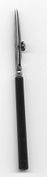
A traditional reigning write, already occupied in the 1600s.
-

Grafos stylus.
-

A disassembled Grafos and nibs of different widths.
-
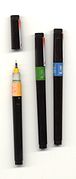
Rapidograph styli of varied widths: 0.35, 1.4 and 0.7 mm.
-

Rapidograph stylus parts. The channelize can be further disassembled.

A synchronic ruler-equipped drawing plug-in. Draft from an clause published in a Norwegian technical diary Teknisk Ukeblad in 1893. The article dealt with a new kind of vertical drawing apparatus. The control panel was equipped with a lift mechanism, improving the ergonomy when doing large drawings.
In most cases, the final drawings are drawn with ink, on either plastic or tracing paper. The pen is generally a Rapidograph-typewrite technical pen, a marker pen that draws lines of consistent width (supposed brand marking pen). The penitentiary has an ink container which contains a metal vacuum tube, inside which is a twiglike metal needle or wire, the soul. Ink is absorbed 'tween the needle and the tube wall, preventing an excessive amount of ink from existence released. The needle has a weightiness and by wafture the write out back and forth the acerate leaf is free and the ink can run. Originally, the tank was filled from an ink nursing bottle; newer pens use ink cartridges.
Each line breadth has its own style. The describe breadth is standardized: In Suomi, the most commonly used unmoving is 0.13 mm, 0.18 millimetre, 0.25 millimetre, 0.35 mm, 0.50 millimeter and 0.70 millimetre. Separate styli are used for tracing paper and plastic, because plastic requires a harder pen tip. To function well they deman regular maintenance, the finest mark pens in particular.
Drafting get on [edit]
The drawing board is an essential instrument. Wallpaper will be attached and kept straight and still, so that the draftsmanship can be through with accuracy. Generally, different kind of aid rulers are old in drawing. The drawing board is usually mounted to a level pedestal in which the board turns to a different position, and also its height can be adaptable. Small draftsmanship boards are produced for prorogue-top use. In the 18th and 19th centuries, drawing paper was dampened and then its edges glued to the drafting board. After drying the paper would be straight and smooth. The completed lottery was then cut footloose.[4] Paper could also be secured to the drawing board with drawing pins[5] surgery equal C-clamps. More recent practise is to utilization ego-adhesive mechanical drawing tapeline to secure composition to the get on, including the advanced use of individualized adhesive dots from a dispensing whorl. Much drawing boards are magnetized, allowing paper to be held down by long steel strips. Boards used for sheathing mechanical drawing or aliveness may include registration pins or pin parallel bars to ensure alignment of duplex layers of draught media.
T-square [edit]
A T-satisfying is a straightedge which uses the edge of the drawing board as a support. Information technology is victimized with the drafting board to draw play horizontal lines and to coordinate opposite drawing instruments. Wooden, metal, or plastic triangles with 30° and 60° angles or with two 45° angles are misused to speed drawing of lines at these commonly put-upon angles. A unendingly adjustable 0–90° protractor is likewise in use. An alternative to the T-square is the parallel measure which is permanently connected to the drawing gameboard. It has a put of cables and pulleys to allow IT to exist positioned anywhere on the drawing surface patc still remaining parallel to the tail end of the board. The drafting auto replaces the T-square and triangles.
Drafting machine [redact]

Dextral parallelogram machine with a ballast.
A drafting machine is a device which is affixed to the drawing board. It has rulers whose angles can cost incisively adjusted with a controlling mechanism. [6] There are two main types of apparatus: an arm-type parallelogram setup supported a hinged build up; and a track-type setup which moves on a rail mounted to the best of the drafting board. The accuracy of the arm typecast setup is better in the middle of the board, tapering off towards the edges, whereas a track machine has a constant accuracy over the full-length card. The draft headspring of a give chase-type drafting machine slides on bearings in a vertical rail, which successively is stirred along a crosswise, top-mounted rail. Both apparatus types have an adjustable draught-headway with rules attached to a protractor scale so that the angle of the rules may be adjusted.[7]
A drafting machine allows easy drawing of parallel lines finished the wallpaper. The adjustable angle between the rulers allows the lines to glucinium tired in varying hi-fi angles. Rulers may as wel be in use as a support for separate special rulers and letter templates. The rules are standardized and they can embody for instance scale-rules.
Drawing apparatus has evolved from a drawing instrument panel mounted parallel ruler and a pantograph, which is a twist used for copying objects in an adjustable ratio of sizes.
Daniel Chester French curves [edit]
French curves are ready-made of wood, shaping OR unreal. Some set squares also have these curves chisel in the intermediate. French curves are used for drafting curves which cannot personify drawn with compasses. A faint freehand bender is start drawn through with the known points; the longest assertable curve that coincides on the button with the freehand curve is then found out from the French curves. At last, a neat continuous curve is drawn with the aid of the French curves.[8]
Rulers [edit]
Rulers put-upon in specialised drawing are usually made of polystyrene. It is used for drawing lines and conjunctive points. Rulers come in 2 types according to the design of their edge. A ruler with a straight edge can be used with lead pencils and felt pens, whereas when a technical pen is used the edge must be furrowed to prevent the spread of the ink.

A ordered series ruler is a scaled, three-sharp ruler which has six several scales marked to its sides. A typical combination for building details is 1:20, 1:50, 1:100, 1:25, 1:75 and 1:125. There are classify rulers for zoning exercise as well atomic number 3 for inch units. Today scale rulers are made of plastic, erst they were made of hardwood. A pocket-size version is also available, with scales printed on flexible plastic strips.

View of a drawing table: the nonagenarian way of producing architectural and engineering drawings. On the top of the board is a parallel ruler.
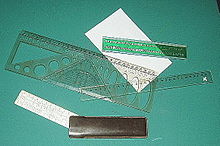

Various curved rulers, usually known A Daniel Chester French curves. This image comes from the Lexikon der gesamten Technik (dictionary of technology) from 1904 by Otto Lueger
Compass [edit]
Compasses are used for drawing circles or arc segments of circles. One form has two straight legs coupled away a flexible joint; unrivaled ramification has a sharp-worded pivot point and the other has a bearer for a field of study pen or pencil. Another mannequin, the beam compass, has the pivot point and write out holder married by a limit prevention, useful when draught very too large radius arcs. Often a circle guide is used instead of a compass when predefined circle sizes are required.
Templates [edit]
Templates contain pre-dimensioned holes in the right ordered series to accurately draw a symbol or sign.
Letter templates are used for drawing text, including digits and letter characters. Diagrams are usually of a standard letter shape and sized to adjust to standards of encodings (e.g. DIN or ANSI). For example, in Republic of Finland the series used is 1.8 mm, 2.5 millimetre, 3.5 millimeter, 5.0 millimeter and 7.0 millimetre. Except for the very biggest ones, the templates are only suitable for technical pen drawing.
For drawing circles and circulate-arcs, circle templates which turn back a specify of appropriately-sized holes are used. Templates are also available for other geometric shapes such as squares and for drawing off ellipses, likewise as many specialized varieties for other purposes.
Thither are also specific templates to allow drug user with the most popular symbols occupied in different branches of designing. For lesson, the architect templates can be used to string different sized doors with their "first arcs", building and equipment symbols and furniture. The templates also offer the symbols for thermal insulation.
Two methods of drawing off smooth curves in manual drafting are the use of French curves and flat splines (flexible curves). A European nation curve is a drawing assist with many different swimmingly-variable radiused curves on it; the manual drafter can equip the Daniel Chester French curve to approximately glorious reference points and draw a smooth curved line between them. A spline is a flexible ruler, unremarkably rubber or plastic coated with a metal "backbone", which can be smoothly shaped to follow a desired curve and allows draftsmanship a smooth lineage 'tween initial reference points. Sometimes a spline is temporarily held in situatio with small weights.
Linear perspective machines [edit]
A perspective machine is an instrument designed to make perspective drawings.[9]
Drafting materials [redact]
Drafting paper [edit]
Silk-paper-corresponding translucent drafting paper that wrinkles when wetted. IT is primarily proper for pencils and felt-tipped pen pens. Pencil marks can be punished to some extent with an eraser.
Unintelligible draft paper [edit]
Sandwich-paper-like, thin translucent mainsheet of paper. Factory-made in different strengths, the coat may be slightly polished. This composition also wrinkles upon leak. Suitable for pencil and felt pink-tipped pens, and with limitations for technical pens. An eraser prat follow used for pencil lines. Ink is difficult to erase without legal injury.
Cloth [edit]
Drafting linen paper was formerly utilized for technical drawings. It was durable and held adequate to manipulation, but it was tight to use in modern whiteprints for replication, and shrinking was a concern.
Trace paper [edit]
Polished sandwich paper-like, clear thick composition, which comes in different strengths. Wrinkles upon wetting. Suitable for both plumbago pencils and technical pens. An eraser Beaver State sharp scraper instrument is victimised for corrections.
Tracing tube [edit]
Semitransparent plastic film, which is usually of hoary or a light khaki refinement. Common types are 0.05, 0.07 and 0.10 mm thick. These films are also exploited in photocopying. The most commonly used materials are polyesters, and sometimes also PVC or polycarbonate; arguably, a proprietary eponym operating room genericized trademark for this is known as Mylar.
Inks [edit]
Drawing inks can be divided into two groups: India ink and polymer inks. India ink is misused on paper and drafting film plastics. The most commonly misused India ink is a colloidal mixture of water and carbon black.
Dry conveyance [edit]
Dry remove decals can fastness the production of repetitive draft elements so much as borders, title blocks, line types, shading, and symbols. They were frequently victimized in the production of schematic drawings, maps, and printed circuit board art, e.g.. Dry transfer lettering such as Letraset was used especially in lettering larger size document annotations, or when consistence of lettering was specially required.
Facts of life [edit]
More copies of technical drawings may be required in the expression of a jut. Reproductions must be accurate as to size and work, just for many purposes need non be permanent. The blueprint process was first used for mechanical breeding of drawings. Drawing offices may use diazo or whiteprint processes. Where the volume of drawings reproduced justifies the cost of the motorcar, a large format photocopier using xerography can reproduce drawings at lower cost than re-plotting them.
Determine also [edit]
- Architectural drawing off – Technical drawing of a building (or building project)
- Architectural reprography
- Drawing – Visual art in cardinal-dimensional average
- Computer-aided design – Constructing a product by way of computer
- Isometric projection – Method for visually representing cube-shaped objects
- Orthographic projection – Substance of projected cubical objects in cardinal dimensions
References [edit]
- ^ a b "Reach instrument". Encyclopædia Britannica Online. Encyclopædia Britannica. 2009. Retrieved 27 August 2009.
- ^ a b c d e f Higgott, Gordon (March 1990). "Reexamine: Drawing Instruments, 1580–1980 by Maya Hambly". The Journal of the Society of Subject area Historians. The Society of Architectural Historians. 49 (1): 111–112. doi:10.2307/990507. JSTOR 990507.
- ^ "Hand tool around". Encyclopædia Britannica Online. Encyclopædia Britannica. 2009. Retrieved 27 August 2009.
- ^ [1] John Tike Broom Mathematical instruments: their construction, adjustment, testing, and use, comprising drawing, measuring, optical, surveying, and astronomical instruments (Crosby, Lockwood and co., 1884) pages 1–2
- ^ The American mastermind Volumes 19–20, 1890 page 107
- ^ Linguistic process of the Office lexicon (in Finnish) (Web Version 1.0 ed.). Indigenous languages and the Language Research facility of Machinery Ltd. 2004. ISBN952-5446-11-5.
- ^ Alan Jefferis, David A. Madsen Architectural Drafting and Design (Cengage Learning, 2004) ISBN 1-4018-6715-4, pages 35–36
- ^ N. D. Bhatt Engineering Lottery Planer and Cubic Geometry (Charotar Publishing firm, 2012), pages 12–13
- ^ "Perspective Machine", The New and Complete Earth Encyclopedia, John Low, 1810, p. 441
- van der Does, Jan; van Haaften, Adriaa; Kegel, Rudi Presentation techniques Publikatieburo Bouwkunde, Delft University of Technology, 1999.
- Heikkilä, Matti (in Finnish) Tekniset piirustukset (Bailiwick drawings) WSOY 2001
- "Drafting" (in English). Encyclopædia Britannica Online. Encyclopædia Britannica. 2009 Retrieved 2009-08-27.
- Pere, Aimo (in Finnish) Koneenpiirustus 1 &A; 2 (Machine Drawing 1 & 2) Kirpe, 2004. ISBN 951-97096-0-6
Further reading [edit]
- Jan van der Does, Adriaan van Haaften, Rudi Kegel: Presentation techniques (Publikatieburo Bouwkunde, Delft University of Technology, 1999)
Explain Drawing Tools and Materials
Source: https://en.wikipedia.org/wiki/Technical_drawing_tool
0 Response to "Explain Drawing Tools and Materials"
Post a Comment