How Long Before Fukushima Habitable Again
The effects of the Fukushima nuclear blow will be felt for decades into the future, say local and international activists on the 10th anniversary of Nihon'south triple disaster of March 2011, contradicting the Japanese regime's official narrative that the crisis has largely been overcome.
Memories of that March day 10 years ago remain fresh for those who experienced it.
A magnitude nine.0 convulsion off Nihon's northeastern declension – the strongest ever recorded – was followed first by an enormous tsunami and then by the meltdown of three nuclear reactors at the Fukushima Daiichi plant that was built on the coast and destroyed past the power of the moving ridge. Nearly 20,000 people in the country'southward northeast lost their lives.
A decade later, most Japanese in the Tohoku region accept been able to move on with their lives, but in the areas near Fukushima Daiichi, where radioactive particles contaminated the country, recovery has not been and then swift.
"Buildings could be repaired later the earthquake and seismic sea wave," said NGO worker Ayumi Iida. "Only the nuclear disaster hasn't ended. We don't know when it will end."
In the wake of the nuclear accident, the government ordered people in nearby cities to get out, and established radiations exclusion zones around the institute. Nearly 165,000 residents were evacuated at its summit in 2012.
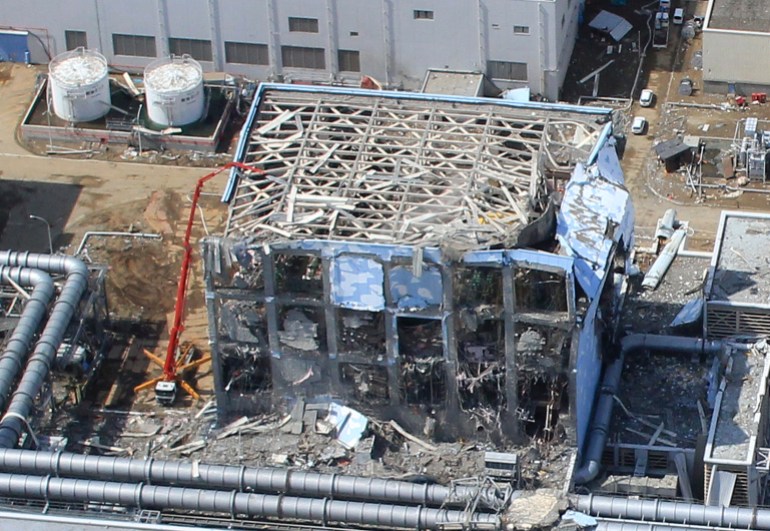
Decontamination efforts accept meant most areas take been reopened and people allowed to return to their homes. Merely in that location are still well-nigh 37,000 people listed as Fukushima evacuees and many of them say they take no intention of going back.
Iida is a spokesperson for a group chosen NPO Mothers' Radiation Lab Fukushima Tarachine, a grassroots organisation established past residents later the disaster to protect the health and livelihoods of children living in the surface area who had been exposed to radiation and other potential sources of damage.
Iida, a young mother who lives in the littoral city of Iwaki, near 40 kilometres (24 miles) from the destroyed constitute, told Al Jazeera English language that she tries to protect her children by sourcing foods from faraway regions of Japan, by finding playgrounds with the lowest levels of radioactivity and by having her children screened each twelvemonth for signs of thyroid cancer.
"Our children have to be the master focus for the future of everything here," she said.
Long-term exposure
While the past 10 years has not seen a significant spike of cancers among Fukushima's population or other obvious signs of radiation-linked diseases – in contrast to Chernobyl which released 10 times more than radiation – experts caution that there remains aplenty basis for business as exposure accumulates over time.
Shaun Burnie, a senior nuclear specialist for Greenpeace Deutschland, says that even at present radiation levels in many parts of the former exclusion zones remain uncomfortably high.
"The level of contamination is such that if these radiation levels were found in a laboratory inside a controlled nuclear facility, information technology would require intervention from at to the lowest degree the plant management, and it would have to be closed off and decontaminated," he said.
Like many other observers, Burnie dismisses claims that the Fukushima crisis is "under control" (as onetime Prime Government minister Shinzo Abe declared as long ago as 2013).

"As long as y'all have that level of contamination in an uncontrolled environs – the forests, the hills, the riverbanks, the farmland – y'all cannot say the situation is under command from a radiological perspective," he said.
Mary Olson, the founder of the US-based Gender + Radiation Touch on Project, points out that the concerns of a young female parent like Iida are not misplaced. While she notes that scientific research on the issue remains underfunded and incomplete, at that place is evidence suggesting that women may also exist more susceptible to cancers acquired by radiation than men.
"Males become cancer. Information technology'southward not that radiation is safety for them," she said, referring to a long-term report done on survivors of Hiroshima. "But the females in the youngest historic period group got twice as much."
She also notes – as practise most nuclear scientists – that while more exposure to radiation carries a larger take chances to human health, in that location is no admittedly "safe" minimum level.
"A fatal cancer tin originate from a single radioactive emission," she said.
On the other paw, in the same mode that climate scientists acknowledge that an individual typhoon or hurricane cannot be attributed to the furnishings of climate change, there is no means to determine whether individual cases of cancer in Fukushima or elsewhere are direct caused past radiation exposure.
The effect tin can only be measured statistically by, for example, comparing the number of cancer cases per 100,000 people in a place similar Fukushima with a different part of Japan.
Little transparency
Many activists merits that the Japanese government and the Tokyo Electric Power Company (TEPCO) really have no involvement in funding and conducting such health impact studies in Fukushima because the answers that they receive could be politically inconvenient for an free energy policy that continues to favour nuclear power.
"Their behaviour is non trustworthy," said Ayumi Fukakusa, a climate justice and energy campaigner for Friends of the Earth Japan, of her regime.
As to the radiation health risks, she contends that "the problem is that the regime doesn't really do research about information technology. Cases of cancer have increased among children … simply they never admit the correlation or causation".

Fukakusa too gives vox to a complaint that is common even among those who are more sympathetic to the government's position – the sense that the officials have done an extremely poor job when information technology comes to transparency, as well as in providing local people credible information about the wellness risks from radiation that might allow them to make more than informed decisions about their time to come lives.
"The important thing is that the government and TEPCO fully disclose the risks and the information virtually the situation," Fukakusa said. "They must be honest with the local people, who must be fully consulted when it comes to relocation and returning [to the former radiation exclusion zones]."
Ten years afterwards the disaster, life has returned pretty much to normal in many parts of Fukushima Prefecture. In some of the inland cities such as Fukushima metropolis or Koriyama, there are few if any visible signs that the nuclear accident ever occurred.
Emiko Fujioka, the secretarial assistant-general of the Fukushima Beacon for Global Citizens Network, says that these days it is mainly only the evacuees from the former radiation exclusion zones who still think nigh it oftentimes.
"In that location is a big gap between the people in Fukushima [city] and the evacuees now," she said.
In the absence of scientific guidance from the regime authorities, communities long ago divided between those who fearfulness the radiation contagion and those who dismiss the risk – sometimes seeing their ain neighbours or family members equally unduly alarmist.
In a somewhat similar style to the current COVID-19 pandemic, local opinion tends to diverge between those who are horrified by the potential health risks and those who are angry at the possible economic damage that could be washed to the community by those who continue to highlight the dangers.

For Ayumi Iida, the young mother who worries about the wellness of her children and those of her neighbours, there is also a broader concern for a globe that all the same looks to nuclear ability as a more than "environmentally friendly" source of energy.
"This time we had an nuclear blow in Fukushima, just we don't know where the adjacent nuclear blow will be," she concludes.
"This must not be seen every bit an free energy and ecology issue merely for Japanese, only it must be considered by people all over the world."
Source: https://www.aljazeera.com/news/2021/3/9/fallout-fukushima-10-years-after
0 Response to "How Long Before Fukushima Habitable Again"
Post a Comment